
AI Risk Classification Model (NIST AI RMF / EU AI Act)
As organizations deploy AI across business, customer, and operational workflows, not every system carries the same level of risk.
This model provides a structured method for classifying AI use cases based on potential impact, regulatory exposure, and operational criticality. Clear risk tiers enable proportionate controls, consistent decision-making, and traceable governance without slowing responsible adoption.
The model is designed to integrate with existing legal, security, risk, and compliance processes rather than replace them.
-
This classification model is used to:
Apply consistent risk logic across all AI use cases
Ensure governance controls scale with impact
Support defensible decisions during audit and regulatory review
Reduce ambiguity in approvals, monitoring, and escalation
Risk classification occurs early in the AI lifecycle and is revisited when material changes occur.
-
This model provides a structured way to classify AI systems based on risk, informed by NIST AI RMF concepts. It is intended to support consistency in governance decisions rather than serve as a compliance determination or scoring mechanism.
-
Tier 1 — Low Risk
Characteristics
Internal or productivity-focused use
No automated decision-making
No sensitive or regulated data
Example Use Cases
Internal summarization or knowledge tools
Non-customer-facing analytics
Governance Requirements
Business owner approval
Basic documentation of purpose and data sources
Periodic review
Tier 2 — Medium Risk
Characteristics
Customer-facing or decision-support systems
Limited personal or regulated data
Human-in-the-loop oversight
Example Use Cases
Customer service copilots
HR screening support tools
Governance Requirements
Legal and security review
Documented safeguards and usage constraints
Defined monitoring plan
Tier 3 — High Risk
Characteristics
Automated or materially impactful decisions
Regulated or sensitive data
Financial, customer, or safety implications
Example Use Cases
Eligibility or suitability determinations
Financial recommendations or scoring systems
Governance Requirements
Executive and risk approval
Formal risk assessment or DPIA equivalent
Ongoing monitoring and defined incident escalation
Tier 4 — Prohibited or Restricted
Characteristics
Unacceptable risk under policy or regulation
Incompatible with organizational risk appetite
Example Use Cases
Uses explicitly restricted by law, regulation, or internal policy
Deployments lacking minimum required safeguards
Governance Requirements
Deployment blocked
Exception process documented if applicable
-
NIST AI Risk Management Framework
Govern: Risk ownership, accountability, and approval authority
Map: Use case context, intended purpose, and impact
Measure: Risk indicators and monitoring expectations
Manage: Controls, escalation paths, and response mechanisms
EU AI Act (Operational Alignment)
Supports early identification of limited-risk versus high-risk use cases
Enables readiness for conformity assessment planning
Does not replace legal interpretation or formal regulatory determination
-
In regulated financial environments, additional considerations apply:
Customer impact and suitability risk
Data retention, auditability, and traceability
Second-line review for high-risk classifications
Documentation sufficient for regulatory examination and internal assurance
High-risk classifications trigger enhanced governance and monitoring expectations consistent with financial services oversight.
-
Clear risk classification reduces ambiguity, accelerates responsible approvals, and ensures AI governance decisions are defensible under audit and regulatory review.
This model enables organizations to adopt AI intentionally while maintaining accountability at scale.
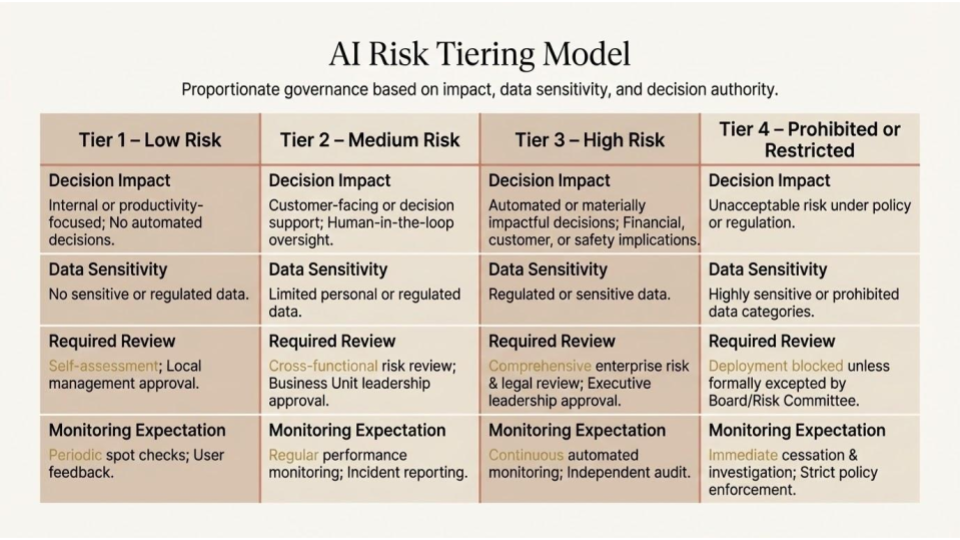
Defines AI risk tiers and regulatory alignment across NIST AI RMF and the EU AI Act to support consistent governance decisions.